Saturday, January 31, 2009

Overview Of Advanced Composition Explorer Mission also called as ACE


ACE (Advanced Composition Explorer) is an Explorer mission that was taken care by the Space Science Mission (SSM)and Payload Development Division(PDD) of the National Aeronautics & Space Administration (NASA).. More on the ACE personnel, Also scientific CoInvestigators can be found here.....

Advanced Composition Explorer Mission was launched on a McDonnell--Douglas Delta II 7920 launch vehicle on August25,1997 from the Kennedy Space Center(KSC) in Florida..


The Planet Earth is constantly bombarded with a giant stream of accelerated particles arriving not only from Sun, but also from galactic sources and interstellar. Studies show these energetic particles contributes to our understanding of the formation & evolution of Solar system as well as the astrophysical-processes involved. Advanced Composition Explorer (ACE) spacecraft carrying 6 very high-resolution sensors & 3 monitoring instruments samples the low-energy particles of solar origin & high--energy galactic particles with a range of collecting power ten to thousand times greater than the past experiments.

These orbits the L-1 libration point which is a point of Earth-Sun gravitational equilibrium about 1.5 million kilometers from Planet Earth % 148 million kilometer from the Sun. From ACE's location @ L1 ACE has a prime view of the solar wind, interplanetary magnetic field & higher energy particles accelerated by the Sun,also particles accelerated in the heliosphere & the galactic regions which are beyond...


(ACE)Advanced Composition Explorer also provides near real time 24/7 continuous coverage of solar wind parameters & solar energetic particle intensities {called as space weather}. When reporting the space weather ACE(Advanced Composition Explorer) provides an early warning (about 1 hour) of geo-magnetic storms that can overload the power grids, disrupt communications on Earth, & present a hazard to astronauts.

ACE spacecraft has enough propellant on the board to maintain an orbit at L-1 until the year 2024.

More information of the ACE mission can be found in the ACE Mission Paper which is published in
Space Science Reviews


About Space Shuttle Mission- STS-119.........


Photo: STS119 Mission Specialists Mr John Phillips, Koichi Wakata & Richard Arnold, they participate in a training session seated on the middeck in one of the full-scale trainers @ Johnson Space Center's (JSC) Vehicle Mock-up Facility. Photo COURTESY: NASA//JSC

The Space shuttle Discovery's STS119 crew is ready to fly the S6 truss segment & install the final set of power generating solar arrays to the (ISS) International Space Station.

The S-6 truss, with its set of large U.S. solar arrays, would complete the backbone of the station & provide one fourth of the total power needed to support a crew of 6.

The 2 solar array wings each have 115foot long long arrays, for a total wing span of 240feet. They would generate sixty six kilowatts of electricity: enough to provide about thirty 2,800-square-foot homes with power.

Commander Lee Archambault would lead Discovery's crew of seven, along with the Pilot Tony Antonelli & Mission Specialists Joseph Acaba,John Phillips,Steve Swanson, Richard Arnold & Japan Aerospace Exploration Agency astronaut Koichi Wakata.


Tuesday, January 27, 2009

Colonies on moon can be built using Lunar rock--like material in future.


Dwellings in colonies on the moon one fine day may be built with a new, highly durable bricks developed by students from the College of engineering at Virginia Tech in the United States.

The building material is composed of a lunar rock--like material mixed with powdered aluminium that may be moulded into any shape,such as a dome. The invention recently won an award from the Pacific International Space Center for Exploration Systems (PISCES), which is dedicated to supporting life on the moon & beyond.

The early--development lunar bricks were based on previous work by the College of Engineering student team’s adviser Kathryn Logan,a professor of materials science & engineering at Virginia Tech.

Logan’s prior research entailed mixing powdered aluminium and ceramic materials to form armour plating for tanks.

“I theorised that if I could do this kind of reaction to make armour, then I could use a similar type of reaction to make construction materials for colonies on the moon,” Logan said.

Since actual lunar rock, known as regolith, is scarce, the students used volcanic ash from a deposit on Earth along with various minerals and basaltic glass, similar to rock on the lunar surface, according to Eric Faierson, a doctoral student who led the Virginia Tech team.

During initial experiments, the simulated regolith & aluminum powder were mixed & placed inside a shallow aluminium foil crucible. A wire was inserted into this mixture, which was then heated to 1,500 degrees Celsius triggering a reaction called Self--propagating High--temperature Synthesis(SHS), Mr Logan said.

The reaction caused the material to form a solid brick.

Once the students team had created a brick, they found it was almost as strong as concrete under
different pressure tests.

The team will now be studying how they can go about harnessing the very large quantities of heat derived from the SHS reaction to produce the electricity for the lunar colony, Mr Logan said.

Thursday, January 22, 2009

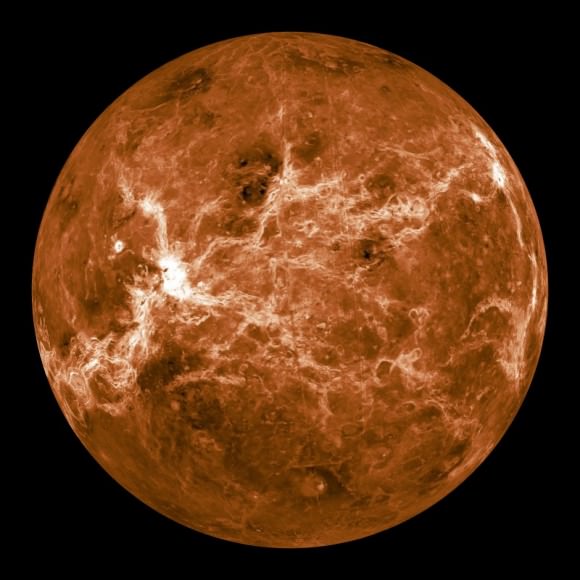
Venus Possibly Had Continents and Oceans.


A look at data gathered by the Galileo spacecraft in year 1990 reveals that Venus at one time might have been habitable, with evidence of past continents & oceans. In a flyby of Venus on the spacecraft's journey to Jupiter, a near- infrared mapping instrument detected signatures which the researchers have interpreted as granite. An international team led by planetary scientist George Hashimoto, at Okayama University, Japan, found that Venus's highland regions emitted less infrared radiation than its lowlands. One interpretation of this dichotomy,says the team's new paper, is that the highlands are composed largely of ' felsic ' rocks, particularly granite. Granite, which on Earth is found in continental crust , requires water for its formation.